

Five Guideposts for the Road Ahead
Practical lessons from four years in Allendale and Hampton County, for any community hoping to expand access to the arts.


Grounded in Evidence
These guideposts come from an independent evaluation led by the University of South Carolina’s Research, Evaluation, and Measurement Center, four years of monthly meeting notes, interviews with project leaders, and conversations with arts coordinators in other rural districts. What follows isn’t a theory. It’s what actually worked, and what didn’t, along the way.”


The Journey Roadmap
 Guidepost 1
 Identify the right individuals to spearhead arts-based learning initiatives as a program manager.
Bring in a dedicated program manager who understands both project management and the arts landscape.
Guidepost 2 Start the journey with capital investments in the arts.
Start with visible, tangible investments, like instruments or classroom upgrades, to build trust and momentum.
 Guidepost 3
 Establish agreements with district or school partners.
Put a memorandum of understanding in place early to protect dedicated time for professional development.
Guidepost 4 Align your arts-based learning initiative with existing strategic plans and state and local mandates.
Fit your initiative into existing district strategic plans rather than competing with state and local mandates.
Guidepost 5 Implement a voluntary model, starting with motivated educators, to build excitement and momentum for your initiative.
Start with your most motivated educators and let their momentum carry others along.
One Early Adopter's Story
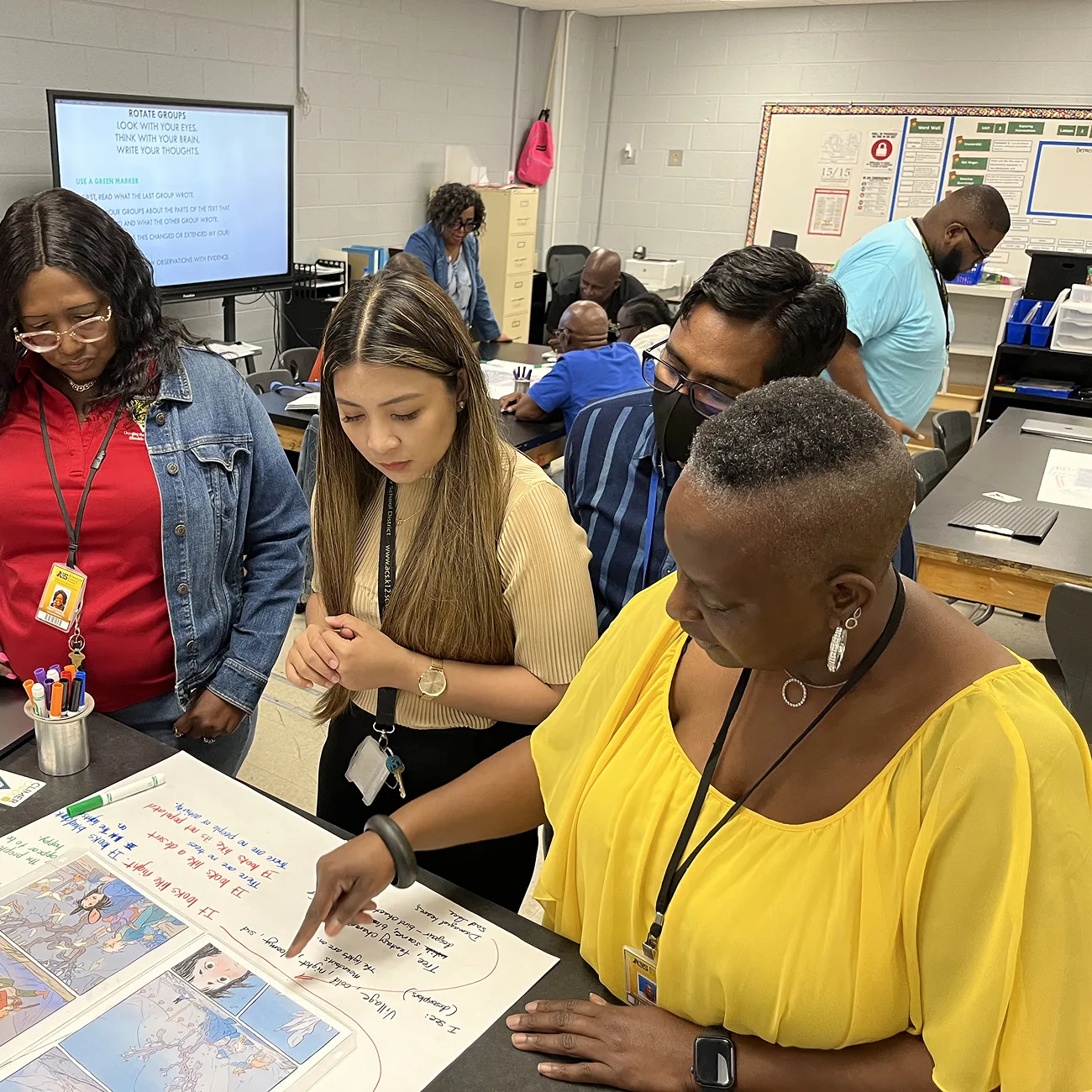
This year, a new position was created at an elementary school in the initial partner district. The position is titled “Exploratory Arts.” A grade-level teacher with decades of dance experience was offered an opportunity to provide arts learning in dance, theater, and visual art. This teacher has been a champion for the CARE Project since it arrived in the school district. She’s attended professional development sessions and served as an instructor at a summer arts learning camp co-hosted by the CARE Project. Now, this early adopter is taking a step further in bringing arts-rich learning experiences to students in her school community.

What’s Next for CARE
The same lessons that guide other communities are now guiding CARE’s own next chapter.